
Low-temperature heat manufacturing
The food, paper, warehousing and other manufacturing industries draw ~60 PJ of fossil gas every year1 - in combination, this is 15% of all industrial gas use
————————————————————————————————————————————————————————————————————————————————————————————————————
The bulk of manufacturing businesses (by employee size) use low-temperature heat in manufacturing applications. These can be summarised in 3 main sectors:
Food and Beverage manufacturing sites range from large-scale to smaller facilities like microbreweries, this group employs 240,0002 across 16,000 businesses,3 the number of people working directly in these factories is ~30,000.4
Paper and pulp manufacturing produces 3.25 million tonnes of paper and paperboard per annum.5 The sector employs around 14,000 workers, mostly in regional Australia, across 117 businesses in the Pulp, Paper and Paperboard Manufacturing industry in Australia.6
other manufacturing includes clothing, wood, fabrication and machinery, employing around 135,000
The Alumina industry is facing serious challenges, with the Kwinana facility now in full curtailment (October 20249) and Rio Tinto's two Queensland Alumina facilities unable to meet contracts in 2024 due to gas supply shortages 10. This highlights that gas is a risky fuel source for metal industries.
While Australia is the world's largest producer of iron ore (953 Mt in 2024)6, it does not produce large amounts of pig iron or steel/steel products (5 Mt in 20247). Iron ore mining is extensive and largely focused in WA, while the steel industry is much smaller and spread out:
four primary steel producers - two in NSW (Port Kembla, 3 Mtpa, Rooty Hill 0.75 Mpta ) and one each in South Australia (Whyalla 1.2 Mtpa) and Victoria (Laverton 0.2 Mtpa), supported by over 300 steel distribution/processing sites and hundreds of manufacturing, fabrication and engineering companies employing ~32,600 people8
Gas use
Over one-third of manufacturing gas, 158 PJ per year (8-year average, 2016/17-2023/24) is used by the aluminium and steel industry:
Aluminium and Alumina refining uses ~143.5 PJ of fossil gas per year, the largest gas use in our industrial sector. This is used primarily as a fuel to achieve process heat required for:
Digestion - 64% of energy use (temperature/gas requirement determined by type of bauxite)
Calcination - 31% of energy use
Other uses (e.g. drying) - 5% of energy use11
In addition to the above, around 15 PJ of gas is used for onsite gas-powered generation
Iron and steel production uses ~14.3 PJ of fossil gas per year, a small amount of gas is used in iron smelting (~4–5 GJ) and the rest in steel manufacturing (~10GJ) like heat treatment, hot rolling and curing.12
Gas substitution pathways
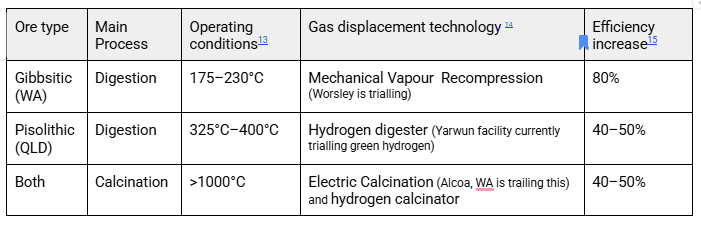
Alumina/aluminium production can be achieved without fossil gas; however, the type of bauxite in use influences the temperature requirements; regional differences in Australia influence the exact technology and approach to be employed:
Make it stand out
Whatever it is, the way you tell your story online can make all the difference.
Both digestion and calcination processes are being piloted in Australia; however, in a recent AEMO report on renewable fuels, it's suggested that hydrogen production for alumina won’t begin until 2051. Action must be taken to change this timeline if efficiency gains and gas savings are to be realised.16
